
How to start.
-
01
Pick a fixed anchor
Attach meditation to something you already do daily, right after you brush your teeth, or before your first coffee. A fixed cue beats relying on willpower.
-
02
Sit and set a timer
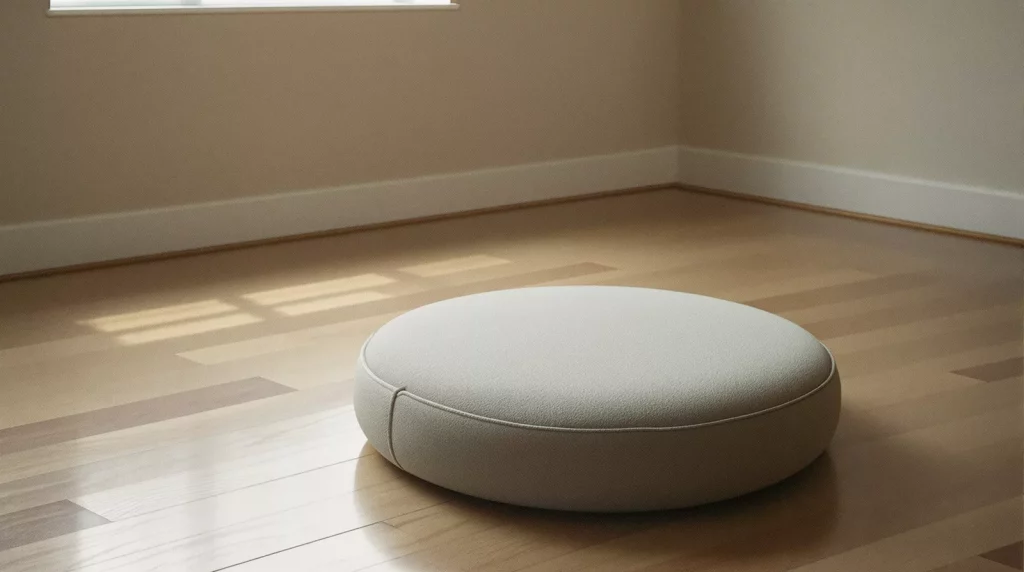
Sit upright, eyes closed or soft gaze down. Set a timer for 10 minutes. No special cushion, app, or posture required to start.
-
03
Follow the breath, return when you drift
Rest attention on the feeling of breathing. When you notice you've wandered, gently return to the breath. That return IS the rep. The wandering isn't failure.
-
04
End without judging the session
When the timer ends, stop. Don't grade whether it was 'good.' A scattered session still counts. Consistency over quality, especially in the first month.
Why it works.
-
Calm
A meta-analysis of 47 trials found mindfulness programs produced moderate reductions in anxiety (effect size 0.38 at 8 weeks) and depression, comparable to an antidepressant in some populations.
-
Focus
Just two weeks of mindfulness training improved working memory and GRE reading scores while cutting mind-wandering, with the biggest gains in people most prone to distraction.
-
Memory
An 8-week MBSR course increased gray-matter density in the hippocampus and other regions, showing meditation physically reshapes brain structure, not just mood.
-
Heart
A randomized trial in adults with elevated blood pressure found an adapted mindfulness program meaningfully reduced systolic blood pressure.
Who swears by it.
Sam Harris
Neuroscientist and author who built the Waking Up app to teach secular, science-grounded meditation.
Jon Kabat-Zinn
Scientist who created Mindfulness-Based Stress Reduction (MBSR), the protocol behind most of the research.
Ray Dalio
Founder of Bridgewater who credits decades of daily Transcendental Meditation as the biggest factor in his success.

John's take.
I went in skeptical, and honestly the science kept me honest about it. The effects are real but modest, meditation didn’t reshape my life, it shaved the spikes off my reactivity. The clearest signal for me: the gap between a triggering email landing and my response getting longer. I notice the urge to fire back, and now I can actually choose not to.
What worked was lowering the bar. I tried 30-minute sessions for a week and quit twice. Ten minutes after brushing my teeth, every day for the last three years, stuck. My personal testing: on days I skip it, I feel it later, in how quickly I get irritable by mid-afternoon. The benefit shows up as the absence of a bad afternoon, which is exactly why it’s so easy to undervalue.
Common questions.
Is 10 minutes of meditation a day actually enough?
Yes, to get the core benefits. Several studies showing reduced anxiety and improved attention used short daily sessions. More time can deepen the effect, but 10 consistent minutes beats an occasional long sit.
How long before daily meditation works?
Most clinical trials run 8 weeks, and that's a fair expectation for noticeable changes in anxiety and emotional reactivity. Some attention benefits showed up in as little as 2 weeks. Give it about two months of daily practice before judging.
Can meditation ever have negative effects?
Yes. Research by Britton and Lindahl documented that a minority of meditators experience unpleasant effects, increased anxiety, intrusive memories, or dissociation, particularly with intensive practice or trauma histories. For most people doing 10 calm minutes a day this is rare, but if meditation consistently makes you feel worse, stop and talk to a professional.
What's the difference between mindfulness and other types?
Mindfulness meditation, nonjudgmental attention to the present, usually the breath, is the form behind almost all the research, including MBSR. Loving-kindness, mantra-based TM, and body scans have their own evidence. For the best-studied default, start with breath-focused mindfulness.
Do I need an app or can I meditate on my own?
You don't need an app. The studies just used guided instruction in a simple technique. A guided app can help in the first few weeks while you learn what 'returning to the breath' feels like. Use one as training wheels, not a permanent crutch.
Is meditation a replacement for therapy or medication?
No. The evidence shows small-to-moderate improvements in anxiety and depression, helpful, but in the range of a modest treatment, not a cure. It works best as a complement to professional care, not a substitute.