
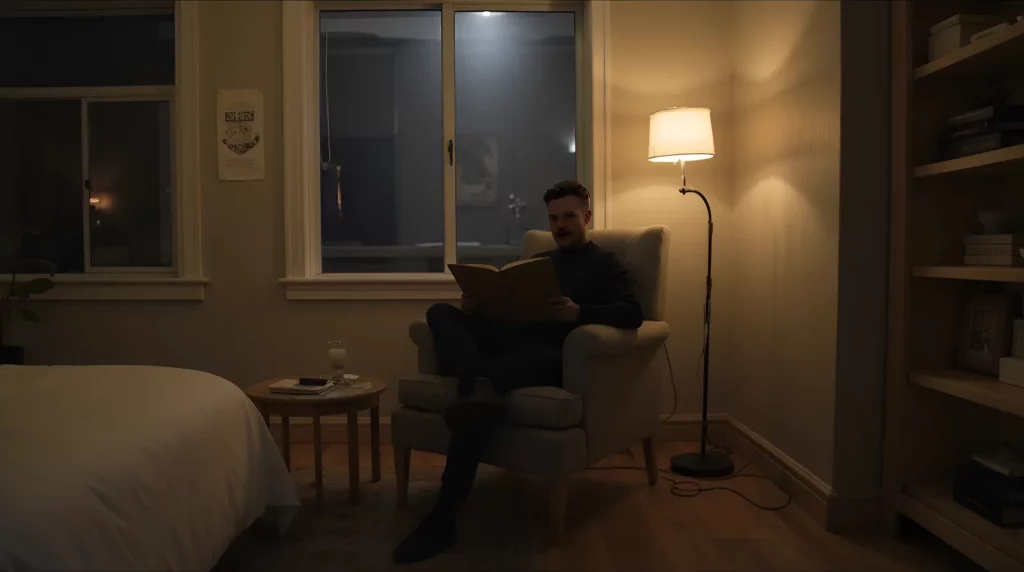
How to start.
-
01
Set a wind-down alarm
Put an alarm 60 minutes before bedtime. It is the only cue that reliably stops you working straight into the pillow and calling it a routine.
-
02
Dim every light
Ordinary room light under 200 lux can cut melatonin by more than half. Kill the overheads, use lamps, get the house down toward candlelight.
-
03
Close the work loop
Write down tomorrow's three tasks and shut the laptop. Ending the day on paper is what stops your head rehearsing it at midnight.
-
04
Do something boring
Paper book, warm bath, light stretching, slow music. Low stimulation is the entire mechanism, so pick the least interesting thing you genuinely enjoy.
Why it works.
-
Melatonin
Exposure to ordinary room light under 200 lux before bed suppressed melatonin by over 50% in about 85% of trials and shortened melatonin duration by roughly 90 minutes.
-
Sleep onset
Reading a light-emitting eReader before bed suppressed evening melatonin about 55%, delayed melatonin onset by more than 1.5 hours and added roughly 10 minutes to sleep onset compared with a printed book.
-
Sleep quantity
A meta-analysis of 20 studies covering 125,198 participants found bedtime screen use roughly doubled the odds of inadequate sleep quantity.
-
Stress
In a randomized trial, a mindfulness wind-down cut total nightly wake time by about 44 minutes and reduced pre-sleep arousal compared with a self-monitoring control.
Who swears by it.
Arianna Huffington
Thrive Global founder and sleep advocate; escorts her phone out of the bedroom nightly for a screen-free wind-down.
Bill Gates
Microsoft co-founder; reads for about an hour before bed every night to wind down and fall asleep.
LeBron James
NBA superstar; avoids TV and phone light for 30 to 45 minutes before bed to wind down.
Barack Obama
Former US president; winds down late reading novels on paper for about half an hour before sleep.

John's take.
Most night routines you read about are content, not routine. Magnesium, chamomile, a gratitude journal, a specific candle. None of that is the active ingredient. The active ingredient is that you stopped an hour early. Look at what the people who are famous for this actually do: Gates reads for an hour, Obama read novels on paper for half an hour. That is it. No stack, no ritual, just a boring hour with nothing to solve in it.
The hour is the hard part and nobody says so. It is not that a paper book is difficult, it is that the hour before bed is the only hour of the day that belongs to you, and this habit asks you to spend it doing nothing impressive. That is a genuine cost. What made it survivable for me was noticing I was already spending that hour, just badly: half-working, half-scrolling, fully awake at 1am wondering why. The trade is not an hour of your life for better sleep. It is an hour you were wasting anyway, spent on purpose.
An honest note on the evidence: it is messier than the confident sleep-hygiene articles suggest. Most of it is correlational or bundles several changes together, so the effect of the wind-down hour by itself is hard to pull out. The controlled light and eReader studies use small, mostly young lab samples. The 44-minute number I like most came from a mindfulness trial in people with insomnia, which is not the same as you having a mildly annoying Tuesday night. The mechanism is sound and the cost is low, so I run it. I would not claim it is proven at the level people imply.
Common questions.
How long should a night routine be?
About 60 minutes. Start winding down an hour before your target bedtime: dim the lights, stop work and move to something relaxing. The hour is less a magic number than a realistic amount of time for arousal to actually fall. Your nervous system does not have a switch, it has a slope.
What should I do in the hour before bed?
Low-stimulation things: a paper book, a warm bath, light stretching, meditation. Just as important is what you drop. Avoid work email, doomscrolling, caffeine, alcohol and intense exercise late in the evening, since all of them raise arousal and push sleep later. The goal is a boring hour, not an interesting one.
Is a wind-down just about avoiding screens?
No, and that is the common misread. Screens matter: bedtime screen use roughly doubled the odds of inadequate sleep across 125,198 people. But ordinary room light under 200 lux cuts melatonin by more than 50% on its own, and work email with the screen off still spins you up. The hour is about light, arousal and stopping, and your phone is one input of several.
Why does dimming the lights matter that much?
Ordinary indoor light is brighter than your biology expects at night. Room light under 200 lux before bed suppressed melatonin by more than 50% in about 85% of trials and shortened melatonin duration by roughly 90 minutes. Dim light is roughly 3 to 10 lux, so lamps instead of overheads is a bigger change than it looks.
Does a bedtime routine actually work for adults?
The best single number: a structured relaxation wind-down cut total nightly wake time by about 44 minutes and lowered pre-sleep arousal in a randomized trial. That is real. The caveat is that much sleep-hygiene research bundles several changes at once, so isolating the hour itself is hard, and real-world benefit depends on doing it consistently rather than occasionally.
Does an evening routine help with insomnia?
The strongest evidence here comes from exactly that population. Ong and colleagues ran a mindfulness wind-down against a self-monitoring control and cut nightly wake time by around 44 minutes. If you lie awake because your head will not stop, the wind-down hour is aimed directly at that. It is not a substitute for treatment if the problem is chronic.