
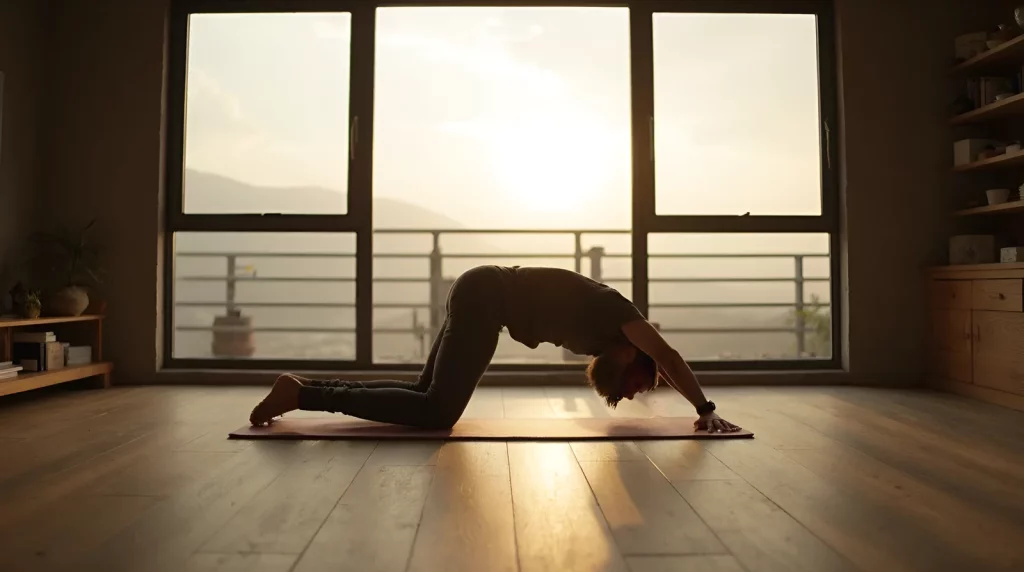
How to start.
-
01
Roll out the mat first
Put the mat where you'll trip over it. The decision you're removing is whether to practice, not which sequence to run.
-
02
Move before you stretch
Spend the first five minutes flowing gently. Tissue is stiffest on waking, so warm the joints instead of forcing depth into them.
-
03
Hold the middle ten
Run a handful of familiar postures you already know. Repetition beats novelty here. The back-pain trials ran ordinary poses for 12 weeks.
-
04
End with breathing
Finish with two minutes of slow breathing or stillness. Skip this and you drop the component that carries much of the effect.
Why it works.
-
Back pain
Across 8 randomized trials covering 743 patients, yoga produced medium-to-large reductions in chronic low-back pain (effect size d=0.62) and in functional disability (d=0.65) versus non-exercise controls.
-
Blood pressure
Pooling 30 trials in 2,283 adults, yoga lowered systolic blood pressure by 7.95 mmHg and diastolic by 4.93 mmHg versus controls. The authors graded the evidence very low quality.
-
Anxiety
Across 8 trials with 319 participants, yoga reduced anxiety with a small effect against no treatment (SMD -0.43) and a large effect against active comparators (SMD -0.86).
Who swears by it.

John's take.
Let me be straight about what the research actually says, because the yoga industry won’t. Nobody has tested 15 minutes of morning yoga. The trials tested yoga, usually 60 to 90 minute classes, usually twice a week, over about 12 weeks. When I tell you to do 15 minutes before breakfast, I’m giving you a schedule that works, not a dose that was measured. Those are different claims and most sites blur them on purpose.
Here’s the part that changed how I practice. In the hypertension trials, programs that combined postures with breathing and meditation got roughly 11/6 mmHg. Postures alone got about 6/3. So the stretching, the thing everyone photographs, is carrying maybe half the load. The breathing, the thing everyone skips because it looks like doing nothing, is carrying the rest. I used to treat the final two minutes as the cooldown. Now I treat it as the point.
The honest tradeoff: this is a low-cost habit with modest, poorly measured benefits. The 2025 meta-analysis rated its own pooled evidence very low quality, and you can’t blind someone to whether they’re doing yoga, so expectation is baked into every result. What I trust more is the back-pain evidence, which is stronger and matches what my body tells me after a decade at a desk. I keep it because 15 minutes is cheap and the injury data looks clean. I wouldn’t sell it as medicine.
Common questions.
Is 15 minutes of yoga a day enough?
It's a realistic starting dose, not a proven one. The trials showing back-pain benefit typically ran 12 weeks of regular practice, and a 12 to 15 minute daily home session fits that pattern. What the research can't tell you is whether 15 minutes matches the longer classes actually studied. Consistency is the part you control.
Does morning yoga lower blood pressure?
Modestly. Across 30 trials in 2,283 adults, yoga lowered systolic pressure by 7.95 mmHg and diastolic by 4.93 mmHg. A drop of roughly 5 to 8 mmHg is meaningful but small, and it sits alongside prescribed medication rather than replacing it. Talk to your doctor before changing anything.
Should I do yoga every day or a few times a week?
Three or more sessions a week was the frequency linked to the largest blood-pressure effects in hypertension trials. Daily is fine and makes the decision easier, since a habit you do every morning needs no scheduling. Below three sessions a week you're probably under the dose that showed results.
What's the most common beginner mistake?
Forcing depth into cold morning joints. Your tissue is stiffest on waking, so the position you can reach at 7am isn't the one you reach at 7pm. Build range gradually instead of chasing maximum stretch. The good news: the anxiety meta-analysis found yoga was not associated with increased injury rates.
Does yoga help with anxiety?
Yes, though the size depends on the comparison. Across 8 trials with 319 participants, yoga beat no treatment with a small effect (SMD -0.43) and beat active comparators with a large one (SMD -0.86). Worth knowing: much of that effect seems to come from the breathing and meditation parts, not the postures.
Is the evidence for yoga actually good?
Not really, and I'd rather say it than hide it. Most yoga trials are small, can't blind participants, and rely on self-reported outcomes. The 2025 blood-pressure meta-analysis rated its own pooled evidence very low quality. The back-pain findings are the sturdiest of the bunch. Everything else is suggestive.