
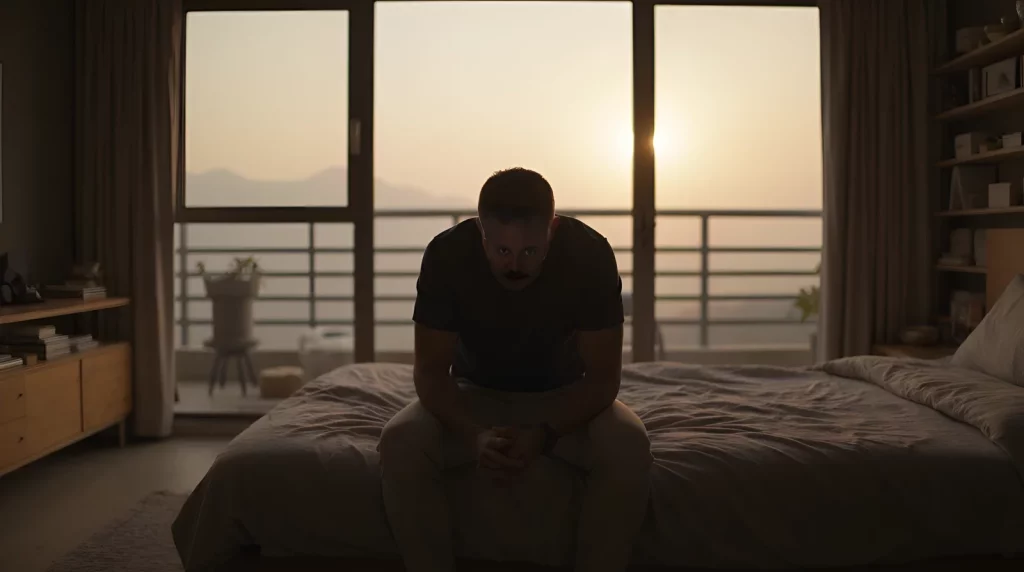
How to start.
-
01
Fix the time
Same minute every day, tied to something you already do. Coffee, first light, kneeling by the bed. The hour matters less than never having to decide.
-
02
Use a form
Thanks, sorry, please, help. Four movements, one minute each. Free-form prayer collapses into worrying with your eyes closed, and a form protects you from that.
-
03
Say it out loud
Even a whisper. Speaking forces the thought to complete itself in a way silent wishing does not, and it keeps you from drifting into your inbox.
-
04
Sit after
Leave 30 seconds of silence at the end without asking for anything. Most people find this is the part they remember, and the part they skip first.
Why it works.
-
Longevity (correlational)
Among 74,534 women followed 16 years, attending religious services more than weekly was associated with 33% lower all-cause mortality versus never attending; observational, not causal proof.
-
Lower depression
In a randomized trial, six weekly 1-hour person-to-person prayer sessions significantly reduced depression and anxiety versus controls, with improvements still present a month later.
Boelens et al., 2009, International Journal of Psychiatry in Medicine
-
Well-being link
Of 326 studies on religiosity or spirituality and well-being, 256 (79%) found significantly greater well-being among more religious or spiritual people.
-
Sense of meaning
In the same systematic review, 42 of 45 studies (93%) found significant positive associations between religiosity or spirituality and purpose and meaning in life.
Who swears by it.
Mark Wahlberg
Practicing Catholic who starts every day with prayer, historically waking as early as 2:30 a.m.
Denzel Washington
Reads the Bible daily and told graduates to put God first and pray daily in thanksgiving.
Dolly Parton
Wakes around 3 a.m. and begins each day with prayer, scripture and meditation.

John's take.
I want to be careful here, because this page will be read by people who pray to someone and people who pray to nobody, and I do not think my job is to sort them. So let me be straight about what the evidence can and cannot carry. The health numbers you have seen quoted, the 33% lower mortality, mostly come from studies of religious service attendance, not private prayer. Attendance means you show up in a room with the same people every week for decades. Researchers themselves attribute much of that to social support, healthier habits and lower depression. If that is the mechanism, then the finding is partly about community, and community is not something you can install alone in your kitchen at 6 a.m.
Then there is the study that should make anyone honest slow down. STEP was the biggest randomized test of praying for other people, 1,802 cardiac bypass patients, and prayer did nothing for recovery. The patients who were told they were being prayed for actually had slightly more complications, 59% against 52%, and the researchers’ best guess was performance anxiety, feeling like you had better get well now that people are watching. Whatever you believe, that result deserves respect. Prayer as a remote medical intervention has been tested about as well as it can be, and it did not show up.
Which leaves the part I think is genuinely defensible: what prayer does to the person praying. A fixed daily point where you say what you are grateful for, name what you did badly, and admit what you cannot control. That is structure, humility and gratitude, delivered daily, in a form humans have kept for thousands of years because it works on us. Meanwhile 44% of American adults still pray daily, down from 58% in 2007, and I would bet the drop costs more than people realize. You do not have to believe anyone is listening for the discipline of saying it out loud to change how you carry the day. If you do believe, you already know that is not the point. Both readings survive the evidence.
Common questions.
Does prayer actually work?
It depends what you mean. Prayer for someone else's recovery has been tested well and failed: the 1,802 patient STEP trial found no effect on cardiac bypass outcomes. Prayer's effect on the person praying looks better, though nearly all of it is observational. Treat it as a practice that shapes you, not a lever on outcomes.
What are the benefits of daily prayer?
The consistent findings are psychological. Across 326 studies, 79% found greater well-being among more religious or spiritual people, and 93% of 45 studies found more purpose and meaning. One randomized trial of six weekly prayer sessions cut depression and anxiety, with gains still there a month later. Physical health links are correlational.
How do I start praying daily?
Fix a time you already own, tie it to an existing habit, and use a form so you are not improvising. Thanks, sorry, please, help works. Five minutes is plenty. Say it aloud, even quietly, and end with 30 seconds of silence where you ask for nothing.
Can prayer help if I am not religious?
The evidence cannot tell you. Every study here measured religious and spiritual people. What is transferable is the shape: a daily fixed pause for gratitude, honest accounting and admitting what you do not control. Call that meditation or reflection if the word prayer does not fit. Do not expect the studies to back that swap.
Why do religious people live longer if prayer does not work?
Because the finding is about attendance, not prayer. In 74,534 women followed 16 years, more than weekly service attendance tracked with 33% lower all-cause mortality. Researchers credit social support, healthier lifestyles and lower depression. People who show up weekly for decades differ from those who do not in many ways, and the studies cannot separate them.
How long should I pray each day?
Five minutes daily beats an hour on Sunday. The randomized depression trial used six weekly hour-long sessions, but that was guided prayer with another person, not a solo routine. For a personal habit, consistency is the variable you control. Same time, same chair, every day, is the version people actually keep.